A proposed year-long 2027 collaboration bringing an authentic Farmwall Symbio aquaponic system, an evolving storytelling panel and four facilitated conversations to the SAFES community.
Proposal · School of Agriculture, Food and Ecosystem Sciences
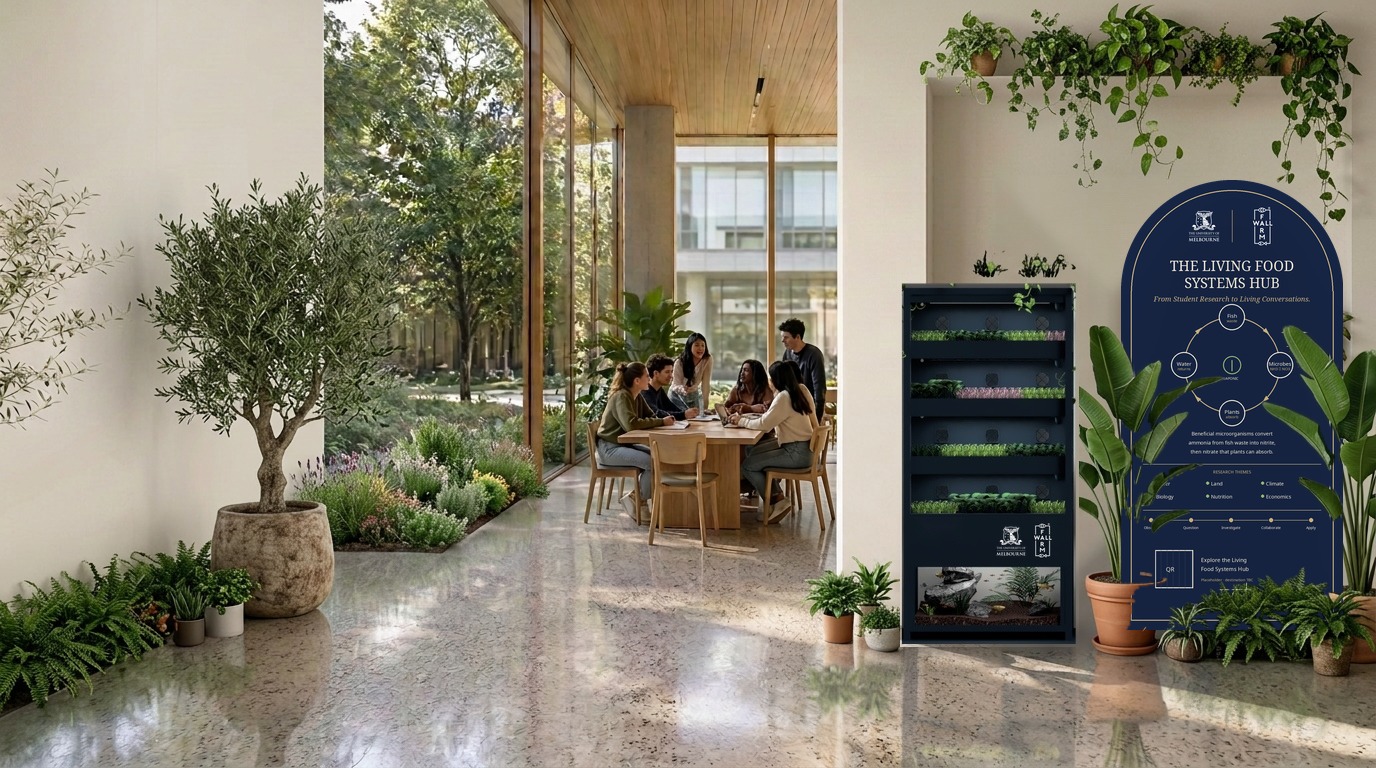
Conceptual setting composed with unchanged official Symbio imagery. Not an approved University location or installation.
Farmwall × University of Melbourne Living Food Systems Hub 2027
1
Symbio installation
1
Educational panel
4
Conversations
01The inspiration
What the students are investigating.
This proposal was inspired by student research presentations on the challenges shaping tomorrow's food systems. Their questions deserve more than a slide deck: they deserve a living, visible place to keep the conversation going.
From curiosity to impact
Observe
Question
Investigate
Collaborate
Apply
Research themes explored through the 2027 journey
Student research · illustrative scene
01
Sustainable agriculture
How food can be produced with fewer inputs and more circular resource use.
02
Food security
Who has reliable access to fresh, nutritious food, and what makes systems resilient.
03
Water
Efficiency, reuse and the relationship between water, nutrients and yield.
04
Climate resilience
Adapting production to shifting conditions and shorter, more local supply chains.
05
The future of food systems
How technology, community and policy might reshape what we eat and how.
02The opportunity
Connecting SAFES research with practical engagement.
See it
A working aquaponic system that makes nutrient cycles, water reuse and plant growth tangible.
Discuss it
Quarterly facilitated conversations linking student questions with practitioners and community.
Extend it
Optional student projects, observations and content that evolve the installation's story over the year.
03The living installation
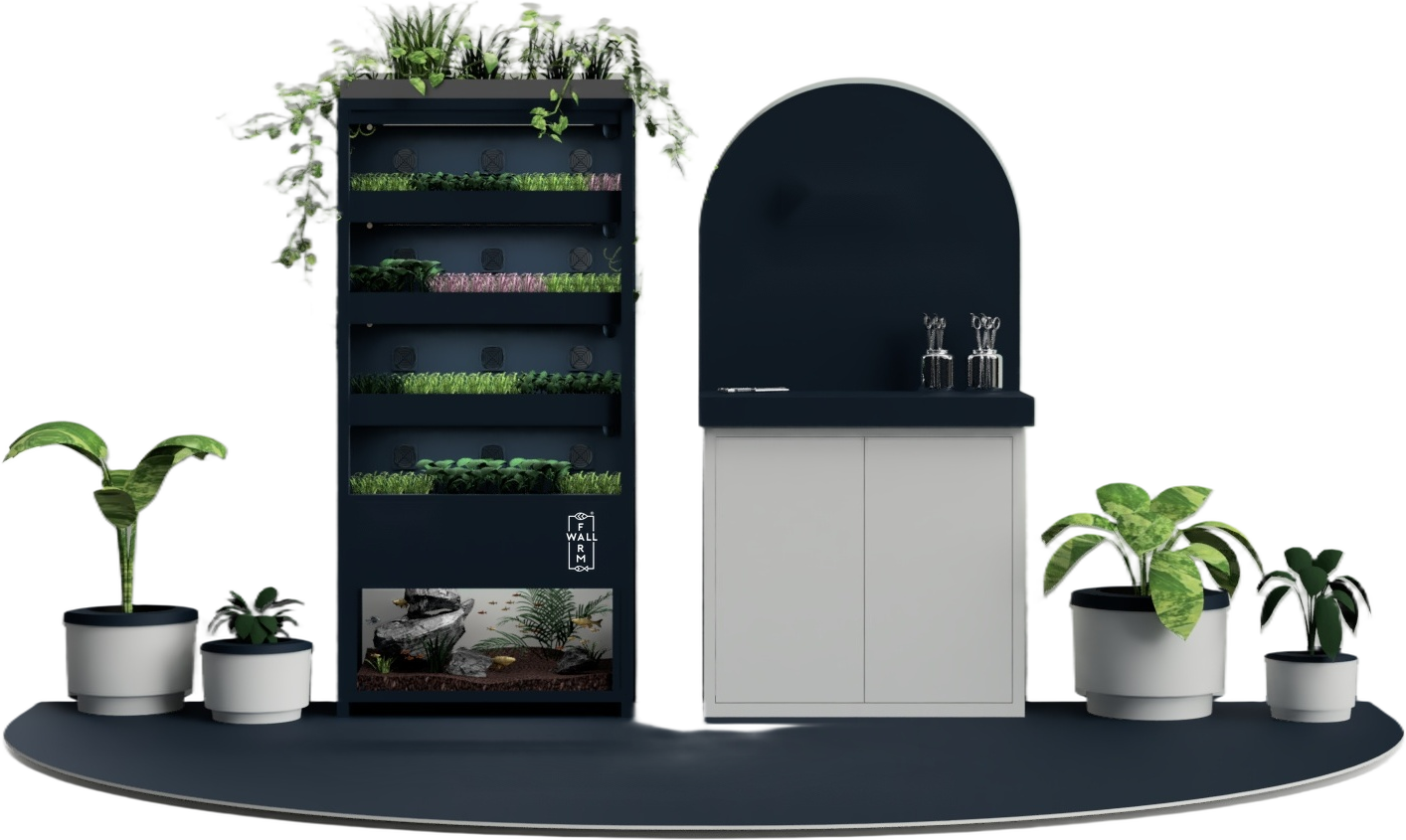
Authentic four-level Farmwall Symbio.
Symbio is Farmwall's aquaponic system: fish and plants in a shared loop, where fish waste nourishes plants and plants help clean the water. Shown here exactly as manufactured, with no redesign.
One unit, four growing levels
Location to be confirmed through site assessment
Care and maintenance approach to be agreed with SAFES
Proposed installation visual, pending site assessment and design approval.
From curiosity to impact
Observe
Question
Investigate
Collaborate
Apply
Where learning begins: a functioning living system
Proposed setting only · location and design subject to University approval
04The communication panel
An evolving educational resource.
A premium, co-branded panel beside the installation explains the system and highlights student research themes. Content is refreshed after each quarterly conversation, so the panel tells the story of the year.
University of Melbourne Proposed SAFES collaboration
THE LIVING FOOD SYSTEMS HUB
From Student Research to Living Conversations.
Fish
Nutrients
Plants
Water returns to the aquarium
Beneficial microorganisms convert ammonia from fish waste into nitrite, then nitrate — plant-available nutrients. Plants absorb these nutrients, and water circulates back to the aquarium.
Current theme: to be set with SAFES for Q1
QR
Explore the Living Food Systems Hub QR placeholder. Destination not yet confirmed and not active.
Illustrative layout only. Final design and University branding subject to approval.
Educational journeyProposed learning outcomes
From curiosity to impact.
A living educational journey connecting food production, research, systems thinking and real-world action. A small living ecosystem can open up conversations about an entire food system.
01
01 · Stage
Observe
Learning begins with living systems.
Students encounter a functioning Farmwall Symbio and observe how plants, aquatic life, water, nutrients and microorganisms interact.
Educational outcomes
Understanding biological growing systems
Observing aquaponic processes
Developing ecological awareness
Connecting food production to everyday environments
02
02 · Stage
Question
Every living system raises bigger questions.
The installation connects to the real challenges explored in the student research presentations. It is not the answer to each one — it is a platform for exploring how they connect.
Water security
Murray–Darling Basin pressures, irrigation efficiency, water allocation and circular water management.
Extreme weather, agricultural adaptation, controlled growing environments and the environmental costs of different production methods.
Biological & chemical systems
Pesticide dependence, integrated pest management, biological alternatives and nutrient management.
Food security & nutrition
Fresh produce accessibility, dietary diversity, supply chain resilience and reliable access to nutritious food.
Agricultural economics & society
Farmer viability, distribution, consumer understanding, incentives, labour and equitable food systems.
03
03 · Stage
Investigate
From observation to evidence.
The installation can prompt research questions and practical investigation. Example enquiries:
Example student enquiries
How much water does the growing system use?
How do nutrient cycles support plant growth?
What are the energy requirements?
How much fresh produce can be grown in a small space?
How do different growing methods compare?
What are the financial and environmental trade-offs?
What role can decentralised production play alongside conventional agriculture?
Educational outcomes
Scientific enquiry · Critical thinking · Data literacy · Life-cycle and systems thinking · Understanding trade-offs · Evidence-based decision-making
04
04 · Stage
Collaborate
Connecting disciplines, people and perspectives.
A place where students, academics, industry and community members can share knowledge across disciplines.
Educational outcomes
Interdisciplinary collaboration
Communication skills
Industry engagement
Stakeholder understanding
Community participation
Translating research for non-specialist audiences
05
05 · Stage
Apply
From ideas to real-world experimentation.
Learning could translate into action. Potential outputs — none are guaranteed:
Potential outputs
Student-generated research questions
Educational resources
Small-scale experiments
Food systems design concepts
Industry collaboration opportunities
New pilot proposals
Public engagement activities
Recommendations for future research
Educational outcomes
Applied problem-solving · Innovation and entrepreneurship · Systems design · Practical experimentation · Understanding implementation challenges · Translating evidence into action
05The 2027 program
Four quarterly conversations.
Select a quarter to explore. Themes are proposed starting points to be shaped with SAFES staff and students.
Proposed quarterly theme · illustrative scene
Growing the Future · Observe & Question
Launch: why living food systems?
Introduce the installation and connect it with student research questions.
How each activation deepens the journey
ObserveQuestionInvestigateCollaborateApply
The installation is active throughout the year — every stage is always available. Filled marks show where each facilitated activation is proposed to focus.
06Student participation
Research and participation opportunities.
From curiosity to impact
Observe
Question
Investigate
Collaborate
Apply
Students move from observation to shared, applied work
Student participation · conceptual scene, not a confirmed activity or location
01
Observation
Record plant growth, water quality and system behaviour across the year.
02
Co-facilitation
Help shape and host a quarterly conversation.
03
Panel content
Contribute research summaries to each panel edition.
04
Project briefs
Possible capstone or elective topics, subject to academic approval.
07Partnership model
A shared model, with potential community support.
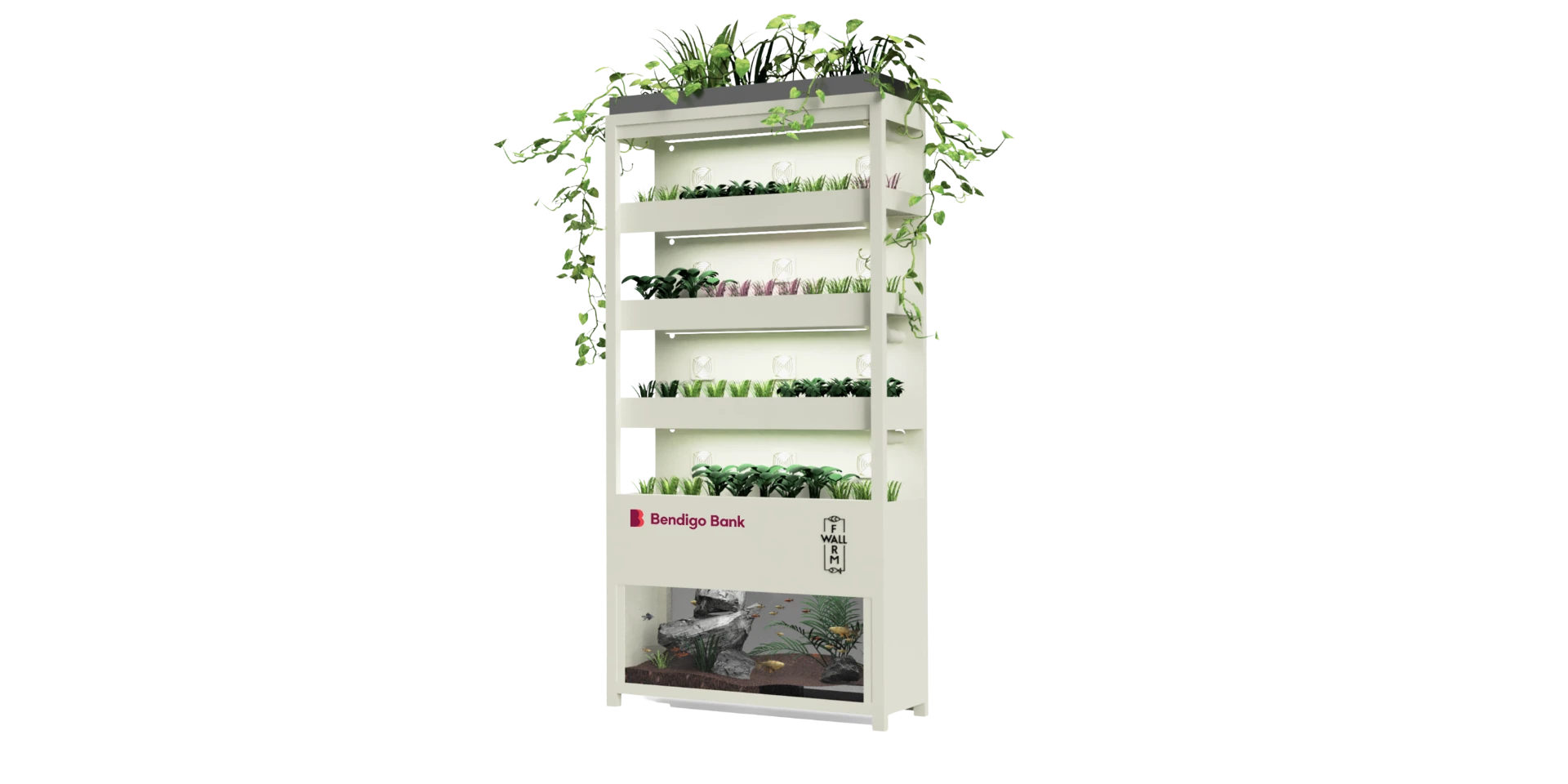
Farmwall would deliver the installation, panel and facilitation. Bendigo Bank may be approached as a potential community funding partner. No approach has been made and no commitment exists.
Supplied branding illustration only — not the proposed black Symbio installation or evidence of a Bendigo Bank commitment.
01 /
Farmwall
Installation · storytelling · facilitation
02 /
University of Melbourne
Proposed academic collaboration
03 /
Bendigo Bank
Potential supporting partner only
Budget item
Amount (AUD)
Proposed funder
Farmwall
$0
University
$0
Bendigo Bank (potential)
$0
TBC
$0
Total
$0
Amounts are intentionally blank. Figures will be provided in a formal quote after site assessment.
08Proposed impact measurement
What we would measure together.
No outcomes are claimed in advance. These are proposed indicators, with baselines and targets to be agreed jointly.
i
Knowledge
What participants understand about food systems and circular production.
ii
Skills
Scientific enquiry, systems thinking, communication and applied problem-solving.
iii
Engagement
Student participation, research discussions and interdisciplinary connections.
iv
Action
Ideas, experiments, collaborations and future pilot opportunities.
Intended learning outcomesWhat the program is designed to support
Activities deliveredConversations, observations and panel editions
Measurable participationWho took part, and how
Longer-term impactsRequire further evaluation beyond 2027
Proposed indicators
Participation
Attendance and diversity of participants at each conversation.
Student involvement
Number of students contributing observations, content or projects.
Learning
Short pre/post reflections on food systems understanding.
System data
Growth and water observations logged by participants.
Panel engagement
Engagement with panel content, once a QR destination is confirmed.
Continuity
Interest in extending the collaboration beyond 2027.
A wider ambition for places of learning and connection · conceptual scene
09 — Partnership invitation
Let's turn research into a living conversation.
1
Introductory conversation with SAFES
2
Site assessment and installation options
3
Agree program themes, roles and budget
4
Explore community funding, incl. a possible Bendigo Bank approach